
Retail Video Analytics: 10 Ways AI Cameras Boost Revenue
By Kushal Sanghvi | March 17, 2026
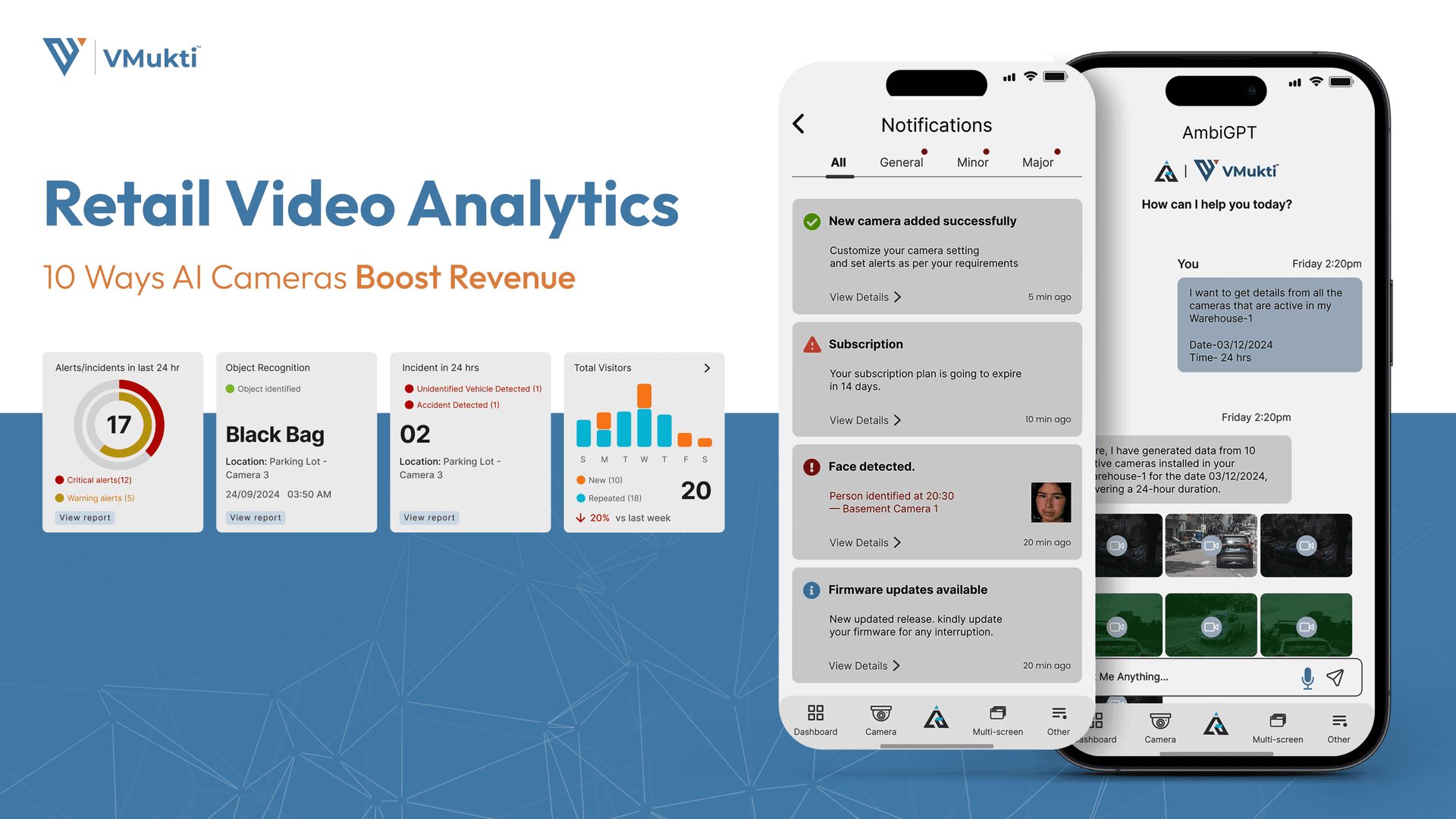
Retail operates on razor-thin margins where small improvements translate to millions in additional profit. Modern AI video analytics transforms cameras into business intelligence tools that simultaneously reduce loss, increase customer experience, optimize labor, and drive revenue growth across multiple dimensions.
10 Ways AI Video Analytics Drives Retail Revenue Growth
10 Ways AI Video Analytics Drives Retail Revenue Growth
First, organized retail crime prevention uses facial recognition and pattern detection to identify repeat offenders, coordinated gang activity, and unusual merchandise dwell times, reducing ORC incidents by 30-50% and saving $2-5 million annually for large chains. Second, shrinkage reduction through employee accountability detects register discrepancies, non-scan incidents, after-hours access anomalies, and refund manipulation, reducing shrink 15-25%. Third, customer behavior analysis provides heat mapping, path analysis, dwell time tracking, and conversion zone identification, driving 5-15% conversion rate increases and 10-20% basket size growth. Fourth, queue management uses real-time occupancy monitoring and predictive staffing to reduce wait times 30-50% and cart abandonment 10-20%. Fifth, planogram compliance verification automates shelf display checking, improving compliance from 60% to 95%+ and increasing revenue 3-8%. Sixth, labor optimization through activity recognition and performance metrics improves productivity 5-10%, saving $500K-$2M annually. Seventh, customer service improvement detects customers waiting for help and monitors service quality. Eighth, promotional effectiveness measurement quantifies campaign ROI, increasing promotional returns 20-40%. Ninth, vulnerable area monitoring eliminates blind spots and enables pre-incident intervention. Tenth, competitive intelligence tracks competitor pricing, assortment, and promotional strategies.
Retail Video Analytics Success Metrics and ROI
Retail Video Analytics Success Metrics and ROI
Key success metrics span loss prevention with 15-30% shrinkage reduction and 30-50% ORC incident reduction, customer experience with 5-15% conversion rate improvement and 10-20% basket size increase, and operational efficiency with 5-10% labor productivity gains and 30-50% checkout wait time reduction. Implementation follows four phases: loss prevention foundation in weeks 1-12, customer experience and operations in weeks 8-20, advanced analytics in weeks 16-28, and multi-location intelligence from week 24 onward. Financial ROI typically reaches 150-400% within 18 months, with annual revenue increases of $500K-$3M per store, shrinkage reduction value of $1-5M for large chains, and labor optimization savings of $300K-$1.5M per location. Most modern AI platforms work with existing IP cameras, preserving 70-90% of current infrastructure during migration.