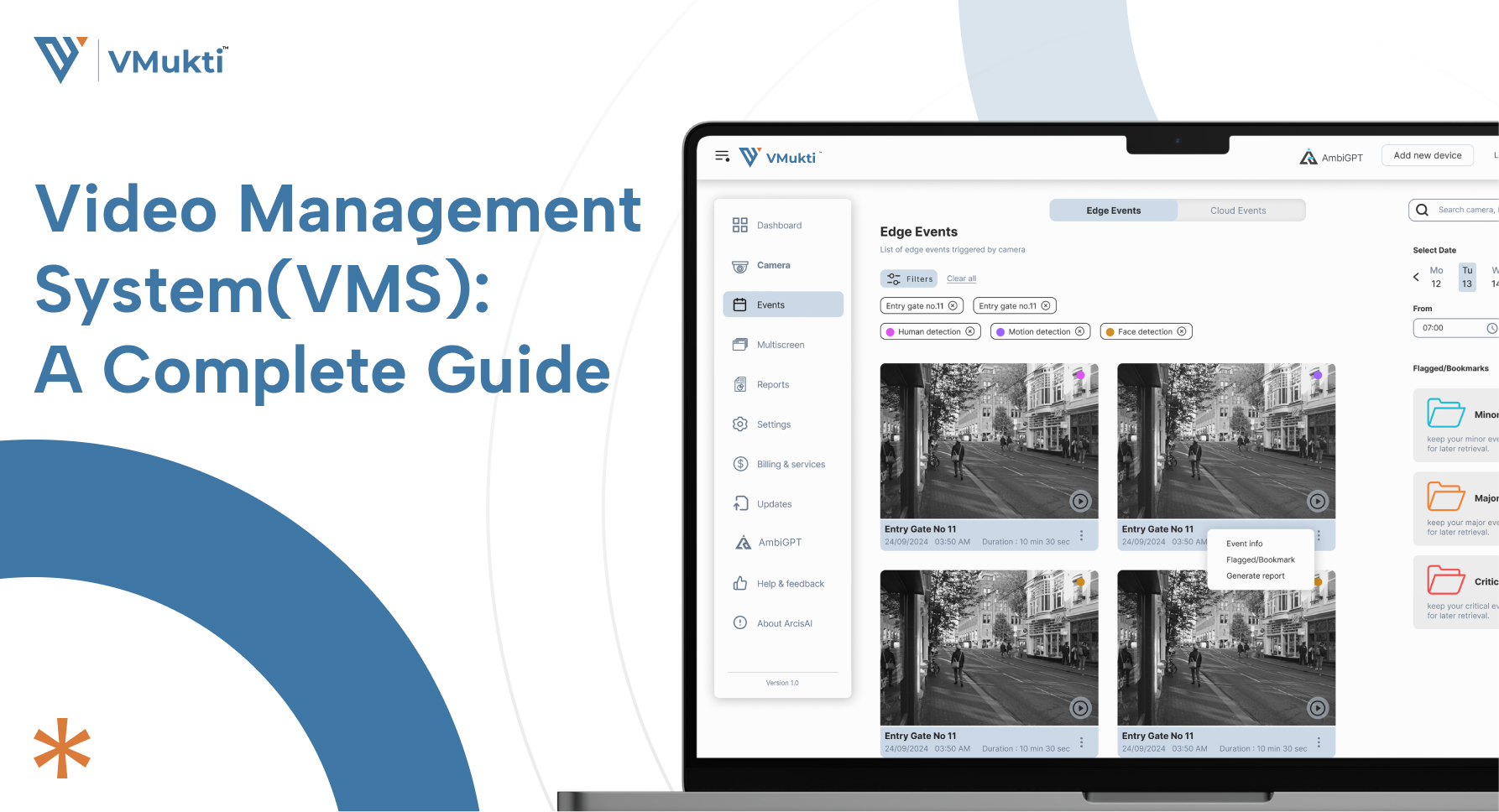
What is VMS? A Complete Guide to Video Management Systems
In the era of digital transformation, surveillance has evolved beyond simple video recording. Organizations—from businesses and enterprises to governments—now handle massive volumes of video data. The global video surveillance market is projected to surge from around , while the overall video surveillance market could reach , reflecting a robust CAGR of roughly 12% toward 2030.
A VMS software offers advanced features such as real-time monitoring, event alerts, AI-driven analytics and remote access. In this guide, we’ll cover what a video management system is, how it works, the essential features and benefits, the key factors to consider when choosing one, and how VMukti Solutions is redefining the VMS landscape.
What is a Video Management System?
A video management system is the central platform of a modern surveillance setup that combines software and hardware to manage, record and monitor video streams from security cameras. It also integrates with devices such as alarms, access control and sensors, ensuring all surveillance data is controlled from one place. Often referred to as the “brain” of a security system, a VMS software not only stores and organizes footage but also provides advanced features like real-time monitoring, event alerts, analytics, and remote access. This makes it an essential tool for businesses, enterprises, and smart infrastructures aiming for efficient and intelligent security management.
How Does a VMS Software Work?
A video management system connects cameras and security devices to a central platform that processes, stores and organizes video data. Acting as the command center, it collects streams, applies storage rules and enables real-time monitoring, making surveillance more efficient, secure and easily accessible across locations. Here’s how a VMS typically works:
Step 1: Video Capture
The VMS receives real-time video streams directly from connected IP cameras.
Step 2: Video Recording
It records the footage continuously or based on scheduled events and triggers.
Step 3: Video Storage
The recorded video is stored securely on local servers or cloud storage with retention policies.
Step 4: Video Access
Authorized users can log in through a central dashboard to view live streams or retrieve past recordings.
Step 5: Video Management
Operators can configure camera settings, manage user permissions and control devices from one interface.
Step 6: Video Analysis
AI-powered tools detect motion, faces, vehicles, or unusual activities within the video streams.
Step 7: Video Alerts
If the system identifies suspicious activity, it generates real-time notifications or alarms for immediate action. By following these steps, a VMS software transforms raw surveillance footage into actionable intelligence that strengthens both security and operational efficiency.
Key Features of Video Management System (VMS)
The features of video management software can vary depending on the provider, but certain capabilities are essential for efficient and intelligent surveillance. Below are the key features to look for in a modern VMS system:
Multi-Camera Management
A VMS allows operators to monitor multiple camera feeds from a single dashboard, whether it’s a few cameras in a retail store or thousands across enterprise locations.
Video Analytics
AI-powered tools such as motion detection, face recognition, people counting and many more detections transform raw footage into actionable insights for proactive security.
Remote Access
Cloud-enabled access lets users securely monitor live feeds and playback recordings from command control centers, smartphones, tablets or remote PCs - anytime, anywhere.
Advanced Search Filters
With powerful indexing and search functions, operators can quickly locate specific footage by date, time, motion events or object detection.
Link Sharing
VMS platforms make it simple to share live feeds or recorded clips with security teams, law enforcement or stakeholders via secure links.
User Permissions
Granular role-based access ensures that only authorized personnel can view, manage or export video of specific cameras enhancing both security and compliance. These features of a video management system make it far more advanced than traditional recorders, providing scalability, intelligence, and flexibility to meet modern surveillance needs.
Benefits of Video Management Software for Modern Security
Deploying a VMS software provides significant advantages for enterprises, government projects, and smart infrastructures. By consolidating surveillance operations, a video management system improves security, efficiency, and operational intelligence across multiple locations.
Centralized Control
A VMS allows operators to manage multiple sites, devices, and users through a single unified platform, simplifying monitoring and administrative tasks.
Enhanced Security
Real-time alerts, AI-driven analytics, and proactive monitoring improve threat detection, helping organizations respond quickly to incidents.
Cost Efficiency
Optimized storage, bandwidth management, and cloud-enabled features reduce infrastructure and operational costs without compromising performance.
User-Friendly Interface
Intuitive dashboards and easy-to-navigate controls allow operators to access video feeds, configure settings, and generate reports with minimal training.
Operational Insights
Advanced analytics provide actionable data for retail traffic, workplace productivity, compliance monitoring, and overall security performance.
Future-Readiness
With AI and IoT integrations, a VMS system evolves with changing security requirements, ensuring long-term scalability and adaptability.
Customizations
Tailor the VMS software to meet industry-specific needs, integrate third-party devices, and configure alerts or reports according to organizational priorities.
Manage and monitor multiple locations seamlessly from one platform, making the VMS ideal for enterprises, chain stores, and government infrastructure. These advantages of video management software illustrate why VMS software is a critical investment for modern businesses seeking smarter, more secure, and scalable surveillance solutions.
Multi-Site Applications
Essential Considerations for Selecting the Right VMS System
Selecting the right video management system software is crucial for ensuring reliable performance, smooth scalability, and long-term ROI. Here are the key factors to evaluate before making a decision:
Compatibility
Choose a VMS that supports IP cameras and integrates seamlessly with third-party devices to ensure smooth deployment and future scalability.
Ease of Use
A user-friendly interface reduces the learning curve, minimizing training requirements for operators and IT teams.
Scalability & Flexibility
Choose a system that can expand easily with additional cameras, users, or storage as your security needs grow.
AI & Analytics Support
Advanced VMS solutions integrate AI features like motion detection, facial recognition, and real-time alerts for proactive security.
Storage Options
Look for flexible storage deployment across on-premise, cloud, or hybrid models to optimize cost and accessibility.
Cybersecurity
Strong encryption, role-based access, and GDPR-compliant data protection are essential to safeguard sensitive surveillance data.
Integration
Ensure seamless compatibility with alarms, access control, sensors, and other third-party security systems for centralized monitoring.
Vendor Support
Reliable after-sales service, software upgrades, and regular patches ensure long-term system stability.
Reliability
The VMS should provide consistent uptime, redundancy features, and failover support to guarantee uninterrupted surveillance.
Smart Search Capabilities
Intelligent search tools allow quick retrieval of video footage by time, event, or AI-based filters, saving valuable investigation time. By considering these factors, businesses and government organizations can select a VMS solution that not only enhances security but also delivers scalability, efficiency, and maximum return on investment.
Which is the Best VMS Software?
When evaluating the best video management software for your organization, VMukti Solutions stands out as a trusted global provider of STQC certified video management solutions. Designed for enterprises, government infrastructure and smart cities. Our VMS system combines innovation, security and scalability with a complete ecosystem of EMS, ICCC, CloudAI, and Cloud Storage - all in one unified platform.
VMukti is recognized globally as a top STQC VMS software provider, offering a complete ecosystem with VMS, EVMS, ICCC, CloudAI and Cloud Storage. Trusted for its reliability, scalability and innovation, it is the preferred choice for mission-critical surveillance.
Conclusion
A video management system is more than just software - it’s the intelligence backbone of modern surveillance. With real-time monitoring, AI-driven analytics, cost efficiency and future-ready integrations, VMS solutions transform how organizations secure and optimize their operations. VMukti Solutions takes this further by delivering a complete ecosystem that includes VMS, EVMS, ICCC, CloudAI and Cloud Storage - ensuring unmatched scalability, security and operational intelligence. Choosing us means investing in a surveillance solution that not only protects but also empowers long-term business value.