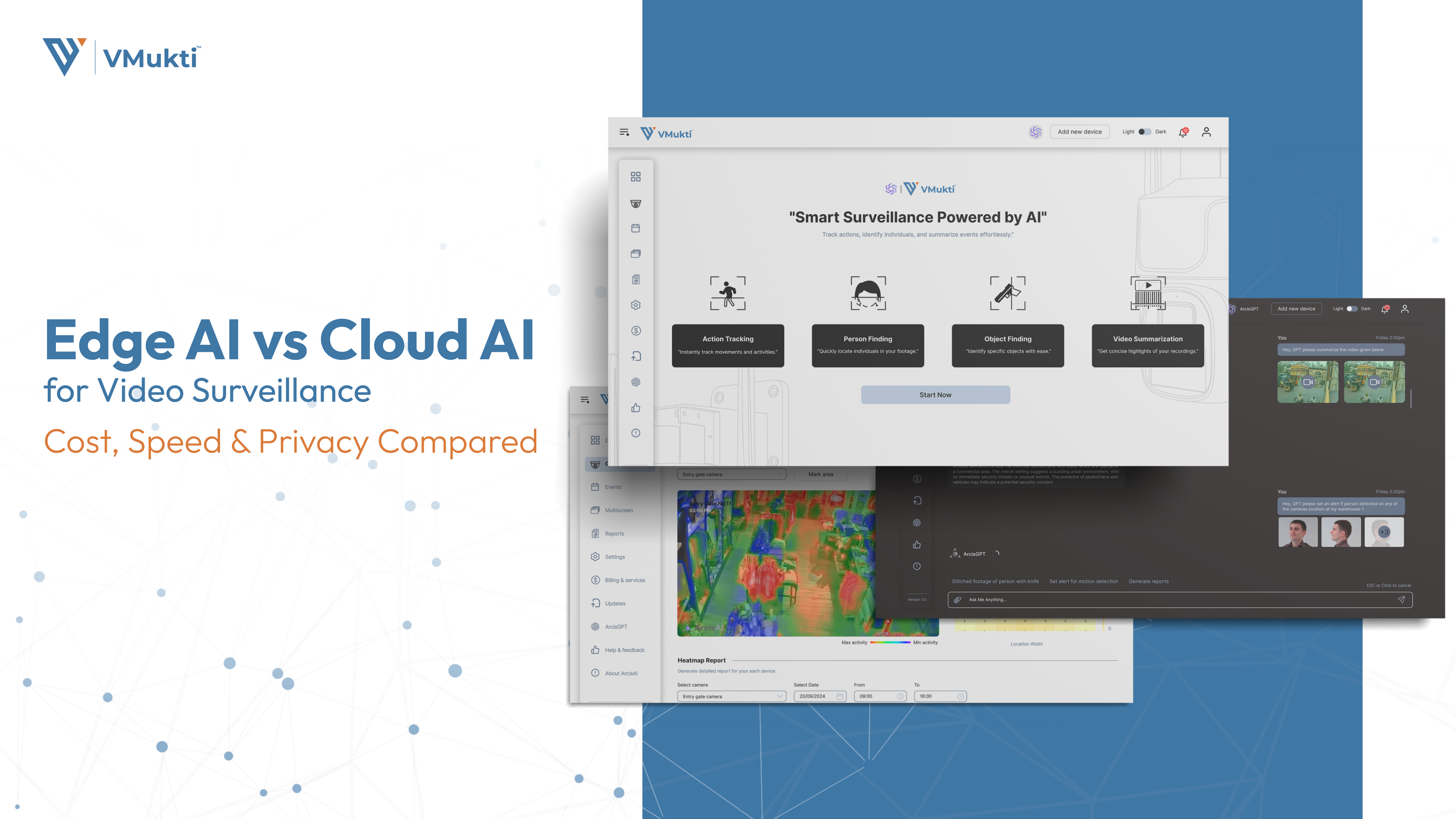
Edge AI vs Cloud AI for Video Surveillance: Cost, Speed & Privacy Compared
The debate between edge AI and cloud AI for video surveillance is reshaping enterprise security architecture. Edge AI processes video directly on cameras or local devices for sub-200ms response times, while cloud AI leverages massive computational power for advanced analytics. This guide compares both approaches across cost, speed, privacy, and scalability to help you choose the right architecture.
Edge AI vs Cloud AI: Understanding the Architecture
Edge AI deploys machine learning models directly on cameras, gateways, or local servers at the point of video capture. AI inference happens in milliseconds without sending video to the cloud, enabling sub-200ms threat detection and immediate automated responses. Cloud AI transmits video streams to centralized data centers where powerful GPU clusters run complex analytics including cross-camera correlation, advanced behavioral analysis, and long-term pattern recognition. The choice depends on your latency requirements, bandwidth constraints, privacy mandates, and analytics complexity needs.
Latency and Real-Time Response: Speed Comparison
Edge AI delivers detection-to-alert speeds of 200-500 milliseconds through on-device processing, enabling incident notifications in under 1 second end-to-end. This speed is critical for active threat scenarios where seconds determine outcomes, enabling immediate human intervention through two-way talk-down before incidents escalate. Cloud AI processing typically requires 1-3 seconds for detection due to network transmission, cloud processing, and response transmission, with total incident notification times of 2-5 seconds. While acceptable for post-incident investigation and pattern analysis, cloud latency is insufficient for real-time threat intervention. For example, during an unauthorized facility entry, edge AI alerts security teams in under 1 second allowing immediate intervention, while cloud AI alerts arrive at 2-3 seconds by which time an intruder has gained significant facility access.
Bandwidth Optimization and Network Costs
A single 4K camera streaming continuously produces 50-100 Mbps of raw video, meaning 100 cameras generate 5-10 Gbps of outbound bandwidth that is impossible for most organizations to handle. Edge AI solves this by processing video on-device and transmitting only relevant metadata at 100-500 Kbps per camera, reducing bandwidth by 80-99%. For 100 cameras, this means 10-50 Mbps total instead of gigabits. Cloud AI alternatives using H.265 compression still require 5-10 Mbps per 4K camera, translating to 500 Mbps-1 Gbps for 100 cameras and significant monthly bandwidth costs of $5,000-$20,000 or more for large deployments. Organizations deploying edge AI across 500 distributed cameras can eliminate $30,000-$100,000 in annual bandwidth costs, making edge processing the clear winner for bandwidth-constrained environments.
Privacy and Data Control
Edge AI provides significant privacy advantages because raw video never leaves the local network. Personal data including faces and characteristics are processed locally and discarded, with only insights like presence detection, zone breach alerts, and crowding notifications transmitted to the cloud. This ensures complete data residency for sensitive facilities and compliance with GDPR, HIPAA, and similar regulations requiring data minimization. Factory footage never leaves the facility, hospital surveillance never reaches external servers, and banking video remains within the secure perimeter. Cloud AI requires raw video to transmit to external servers for analysis, demanding trust in vendor security practices and potentially violating organizational or regulatory data residency requirements. With 53% of organizations citing privacy and security as the primary reason for adopting edge AI, regulated industries increasingly mandate edge processing for surveillance data.
Cost Analysis: Edge vs. Cloud vs. Hybrid
Edge AI implementation requires upfront hardware investment of $10,000-$30,000 per facility for edge servers plus $3,000-$10,000 per location for GPU-enabled edge devices, with software licensing at $500-$2,000 per location monthly. The recommended hybrid architecture combines edge devices with cloud analytics, costing $8,000-$25,000 monthly total including amortized hardware ($833-$2,500/month over 5 years), edge software ($5,000-$15,000/month), and cloud platform ($3,000-$10,000/month) with minimal bandwidth charges. A cloud-only alternative costs $10,000-$35,000 monthly when factoring cloud platform fees plus $5,000-$20,000 in monthly bandwidth for video transmission. Hybrid architectures deliver better performance at equivalent or lower cost compared to cloud-only approaches, particularly at scale, making them the recommended approach for most enterprise deployments.
Implementation Scenarios and Recommendations
For single facilities with strict privacy requirements in healthcare or finance, an edge-first architecture is recommended where video is analyzed locally and only metadata transmitted to cloud for archival and advanced analytics. Multiple distributed locations with limited IT resources benefit from a cloud-first approach with edge optimization at critical security locations. Global enterprises with billions in assets should deploy comprehensive hybrid architectures with edge devices at every location for immediate threat detection and robust cloud platforms for global threat intelligence, representing the gold standard for multinational organizations. Startups and rapidly growing organizations should start cloud-native for simplicity and speed, adding edge processing as specific privacy or latency needs emerge. The edge-cloud distinction increasingly blurs in 2026 as specialized hardware reduces edge costs to $2,000-$5,000 per location and modern architectures process data at optimal locations in a distributed hierarchy.