
What Is Cloud-Based CCTV and How Is It Different from a DVR/NVR?
By Kushal Sanghvi | June 9, 2026
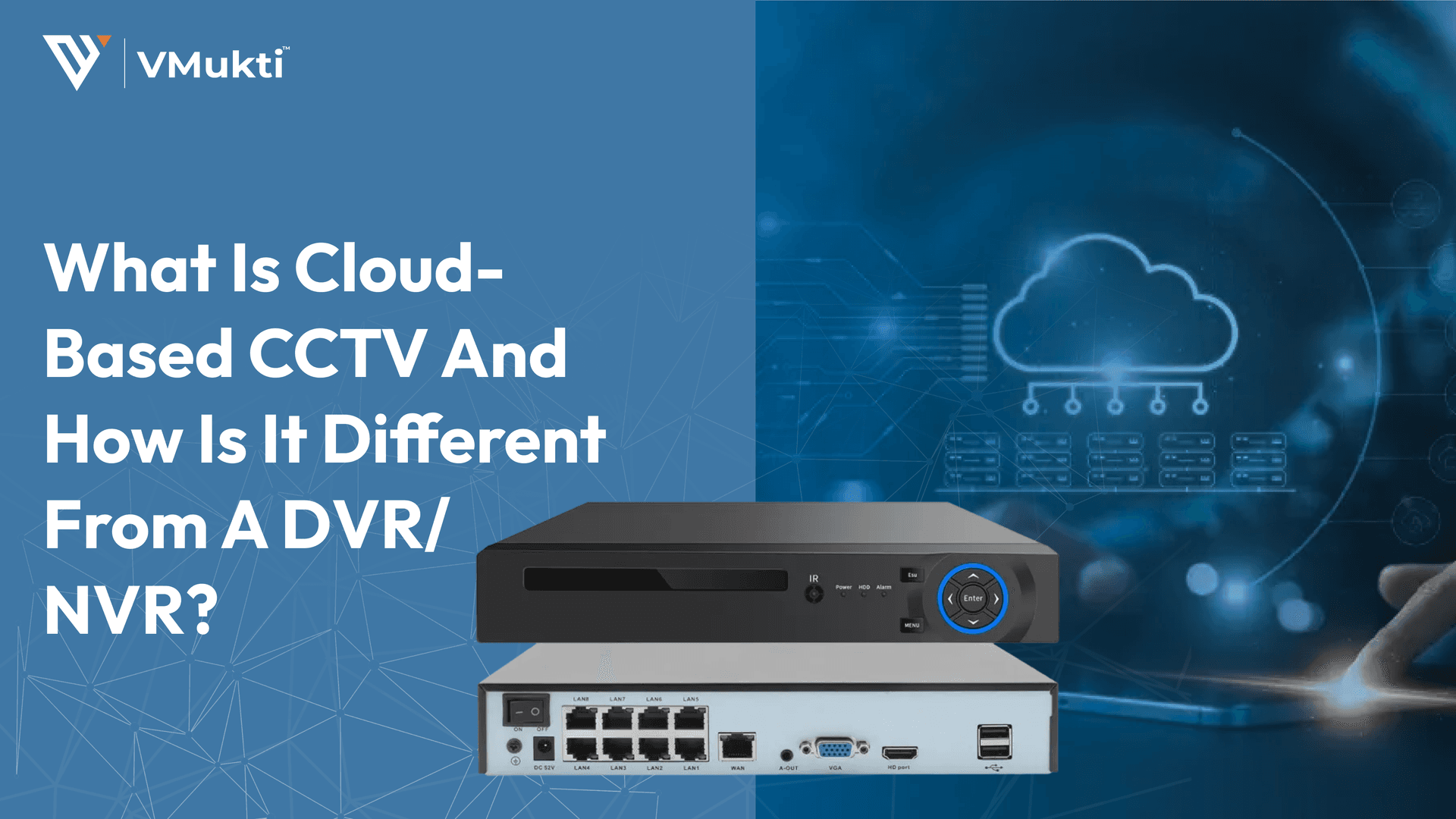
Table of Contents
What Is Cloud-Based CCTV?
How Cloud-Based CCTV Works
What Are DVR and NVR Systems?
Cloud CCTV vs DVR vs NVR: The Core Differences
Why Businesses Are Moving from DVR/NVR to Cloud Surveillance
Cloud-Based CCTV and the Question of Cost
Is Cloud CCTV Right for Your Business?
How VMukti's Cloud VMS Powers Smarter Cloud Surveillance
Conclusion
Something goes wrong overnight. A camera caught the whole thing, but the footage sits locked inside a box at the office, and you are forty minutes away with no way to reach it. Anyone who has run security for a growing business knows that sinking feeling, and it is exactly what cloud based CCTV was built to kill. The cameras on your walls have barely changed. What changed is where the video goes the moment it is captured, and who can reach it when it matters most.
What Is Cloud-Based CCTV?
What Is Cloud-Based CCTV?
At its simplest, cloud based CCTV is surveillance that stops depending on a machine in your building. Your cameras still watch the floor, the gate, the warehouse aisle. The difference is what happens next: instead of feeding a recorder bolted to a wall, they push encrypted video up to secure servers you control through a browser or app. So your footage is no longer trapped in one room. A manager in another city sees the same live feed as the guard on duty, and pulling last Tuesday's clip takes seconds, not a site visit.
How Cloud-Based CCTV Works
How Cloud-Based CCTV Works
The mechanics are simpler than they sound. Each camera captures video, compresses it, and encrypts it before sending a single frame anywhere. From there the stream travels over your internet connection to the cloud, which stores it safely and indexes it, so you find a moment without scrubbing through hours of nothing. Better still, analytics run across every feed in real time and flag trouble for you, from a figure crossing a fence line to the first flicker of smoke. One caveat matters: once video leaves the building, its safety depends on the server it lands on, so a secure, STQC-certified platform like VMukti is worth insisting on.
What Are DVR and NVR Systems?
What Are DVR and NVR Systems?
To judge the cloud fairly, you need to understand what it replaces. A DVR, or Digital Video Recorder, is the older option. It pairs with analog cameras, takes their signal over coaxial cable, and stores everything locally. An NVR, or Network Video Recorder, is the modern relative, built for IP cameras that send sharper video over ethernet. Yet both share the trait that limits them: your footage lives on hardware inside the building. That works fine until the drive fails, a fire takes the room, or someone carries the box out the door, and your evidence goes with it.
Cloud CCTV vs DVR vs NVR: The Core Differences
Cloud CCTV vs DVR vs NVR: The Core Differences
Put them side by side and the divide comes down to where everything lives. DVR and NVR systems keep storage, access, and processing on-site, while cloud video surveillance lifts all three into remote infrastructure. That one choice shapes everything else. Access is the obvious win, since the cloud hands you footage from a phone anywhere, not just the room with the recorder. Scale is the next, because adding cameras to a DVR or NVR means more hardware, whereas the cloud absorbs them with a plan upgrade. And maintenance all but disappears, as updates and disk swaps stop being your team's problem.
Why Businesses Are Moving from DVR/NVR to Cloud Surveillance
Why Businesses Are Moving from DVR/NVR to Cloud Surveillance
The pull is operational, not fashionable. Ask anyone overseeing forty recorders across a dozen cities, each with its own login, and they will describe a daily scramble no staffing truly fixes. A single cloud based view collapses that chaos into one dashboard. Security adds weight too, since footage in one box is a single point of failure, while the cloud spreads it across protected infrastructure, encrypts it, and backs it up automatically. Layer analytics on top, and the system stops being a passive archive and becomes an early-warning network that works while no one is watching.
Cloud-Based CCTV and the Question of Cost
Cloud-Based CCTV and the Question of Cost
Cost is where the conversation gets honest. Traditional DVR and NVR systems front-load the pain, charging heavily up front for hardware and installation before settling into quiet running costs. Cloud based CCTV inverts that curve, dropping the entry price because the bulky recorders vanish, replaced by a predictable subscription. The real story shows up over years. Local setups keep billing you in ways the original quote never showed, from failed drives to IT hours spent nursing old gear. That is why the total cost of ownership tilts toward the cloud the longer you run it and the more cameras you add.
Is Cloud CCTV Right for Your Business?
Is Cloud CCTV Right for Your Business?
The cloud is not automatically right for everyone. A single small premise that genuinely needs everything offline can still be served well by a local recorder. The honest test is how your needs are likely to grow, not how they look today. If you run more than one location, or expect to, the calculus shifts fast. The same holds if remote oversight, strong data security, and easy scaling matter to you. For those organisations, cloud surveillance is not just convenient; it unlocks analytics and controls a closet full of recorders that was never going to deliver.
How VMukti's Cloud VMS Powers Smarter Cloud Surveillance
How VMukti's Cloud VMS Powers Smarter Cloud Surveillance
This is where the platform you choose becomes the whole point. VMukti's cloud-based video management system was built for organisations that have outgrown local recorders, pulling thousands of streams across scattered sites into one secure, scalable view. It is STQC-certified and engineered for large, multi-site operations, so it holds up under the scrutiny enterprise and government deployments demand. On top sits an AI analytics suite handling intrusion, fire, and number-plate detection, which turns passive footage into something that acts on your behalf. For any team hitting the ceiling of its DVR and NVR setup, that pairing makes the move feel less like a gamble and more like an upgrade.
Conclusion
Conclusion
Strip it back and the choice between cloud based CCTV and DVR/NVR is control versus capability. A local recorder still earns its place in a small, fixed setup where simplicity wins. But the moment your operation spreads across sites, the cloud's edge in access, scale, and security becomes the reason the whole system works. The cameras keep watching either way. The real question is whether your footage stays locked in a room, or finally goes wherever you need it.