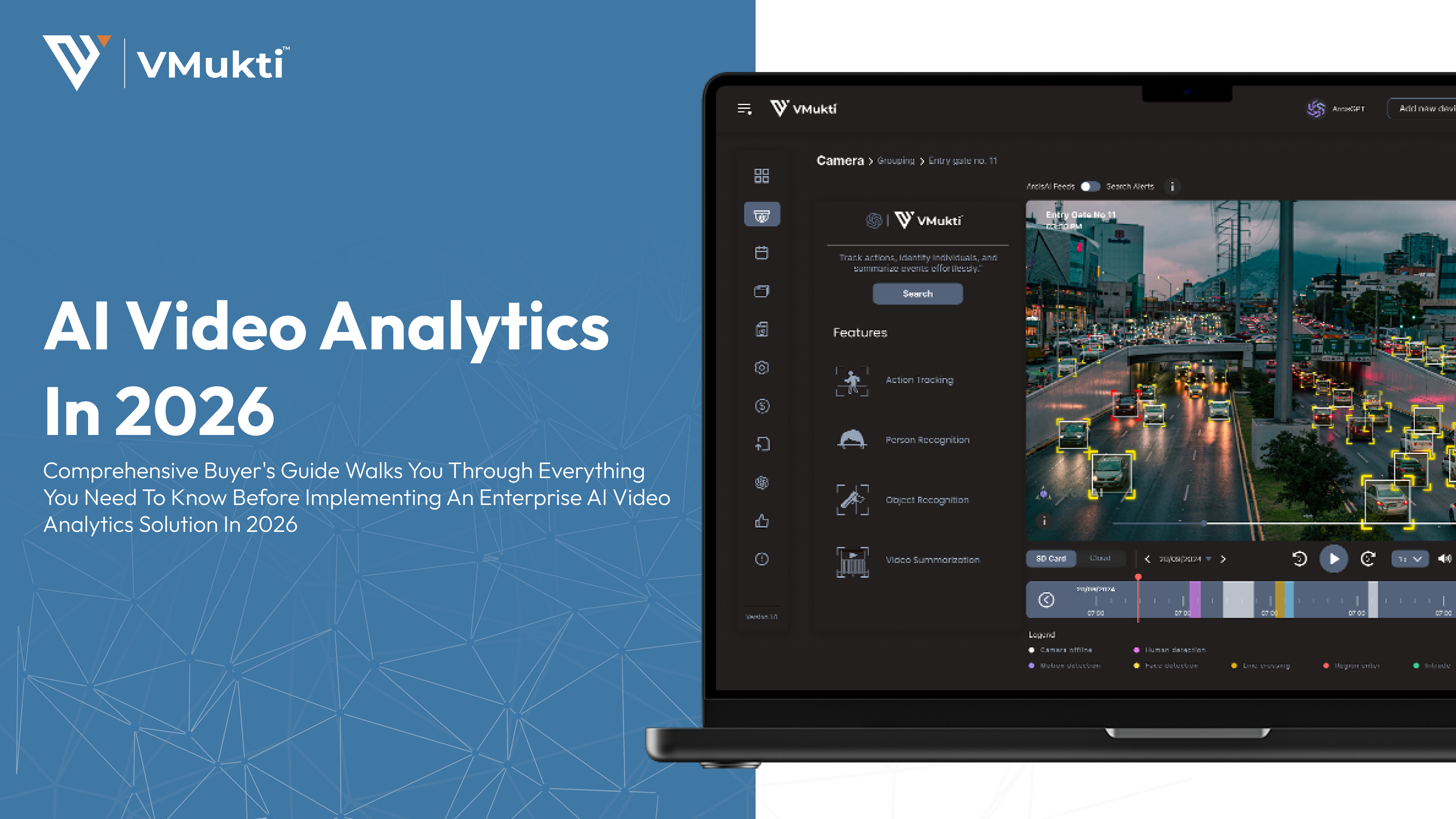
AI Video Analytics in 2026: The Complete Enterprise Buyer's Guide
The global AI video analytics market reached $5.04 billion in 2025 and is projected to expand at a 23.35% CAGR, reaching $17.20 billion by 2030. This comprehensive buyer's guide walks you through everything you need to know before implementing an enterprise AI video analytics solution in 2026 — from key features and deployment models to ROI benchmarks and implementation best practices.
What is Enterprise AI Video Analytics?
AI video analytics transforms raw video streams into actionable business intelligence using machine learning, deep learning, and computer vision technologies. Unlike traditional CCTV systems that simply record footage, modern AI video analytics platforms automatically detect, classify, and interpret complex behaviors, patterns, and anomalies in real-time. Enterprise-grade solutions process video feeds from hundreds or thousands of cameras simultaneously, identifying threats, operational inefficiencies, and business opportunities without requiring manual monitoring 24/7.
Why Enterprises Choose AI Video Analytics in 2026
The shift from reactive to proactive security has become a competitive necessity. Organizations that implement AI video analytics report improved security outcomes, reduced false alarms, and quantifiable ROI within 6-12 months. In 2026, cloud-native migration marks the inflection point where most enterprises transition from capital-intensive on-premise systems to flexible SaaS-based deployments. The emergence of Autonomous AI Agents in video surveillance reshapes how organizations respond to incidents — these systems understand context, interpret intent, and recommend appropriate responses. Edge computing integration allows organizations to process video locally for immediate response while leveraging centralized cloud analytics for long-term insights. Enterprise customers increasingly demand transparent, explainable AI with built-in bias detection and audit trails for compliance.
Key Features to Evaluate in Enterprise AI Video Analytics Platforms
When evaluating solutions, prioritize these critical capabilities: Multi-Camera Orchestration for managing hundreds or thousands of distributed cameras with unified command-center visibility. Real-Time Processing with edge-enabled platforms delivering sub-200ms detection for immediate intervention. Custom Behavioral Rules that enable business teams to create detection rules using natural language without requiring developers. A robust Integration Ecosystem with native APIs connecting to access control, alarm panels, VMS platforms, and business applications. Privacy and Data Governance supporting edge processing, granular access controls, and compliance frameworks for GDPR, HIPAA, and industry regulations. Forensic Capabilities enabling natural-language search and automated incident reconstruction. And comprehensive Analytics and Reporting with customizable dashboards, predictive analytics, and heat-map visualizations.
Cloud vs. On-Premise Deployment: What's Right for Your Enterprise?
Cloud-native deployments offer subscription-based pricing, automatic updates, unlimited scalability, and reduced IT burden. On-premise and edge deployments provide complete data sovereignty, sub-second latency, continued operation during outages, and compliance advantages for regulated environments. For most enterprises, a hybrid architecture is recommended: deploy edge processing at camera locations for immediate threat response and bandwidth optimization, while leveraging cloud platforms for centralized analytics, long-term storage, advanced pattern recognition, and multi-location intelligence. This approach delivers the best of both worlds.
Implementation Best Practices
A phased approach ensures successful deployment. Phase 1 (Weeks 1-4) covers assessment and planning — inventory existing infrastructure, identify high-value use cases, and define success metrics. Phase 2 (Weeks 5-12) is pilot deployment on a subset of critical cameras in one location to test integrations, train staff, and validate the value proposition. Phase 3 (Weeks 13-26) involves full rollout, systematically extending coverage across your organization with advanced behavioral rules. Phase 4 is ongoing optimization — continuously refine detection rules, integrate additional systems, and leverage new AI capabilities as they are released.
Enterprise AI video analytics platforms deliver measurable returns across multiple dimensions. Security metrics typically show 30-50% reduction in incidents, 80% faster incident response times, and significant reduction in false alarms. Operational metrics include reduced shrinkage and loss prevention savings, improved employee safety, optimized staffing through occupancy analysis, and enhanced customer experience through crowd management. Financially, organizations report average ROI of 150-300% within 18 months, payback periods of 12-18 months, reduced security staffing requirements, and lower insurance premiums through demonstrated risk mitigation.