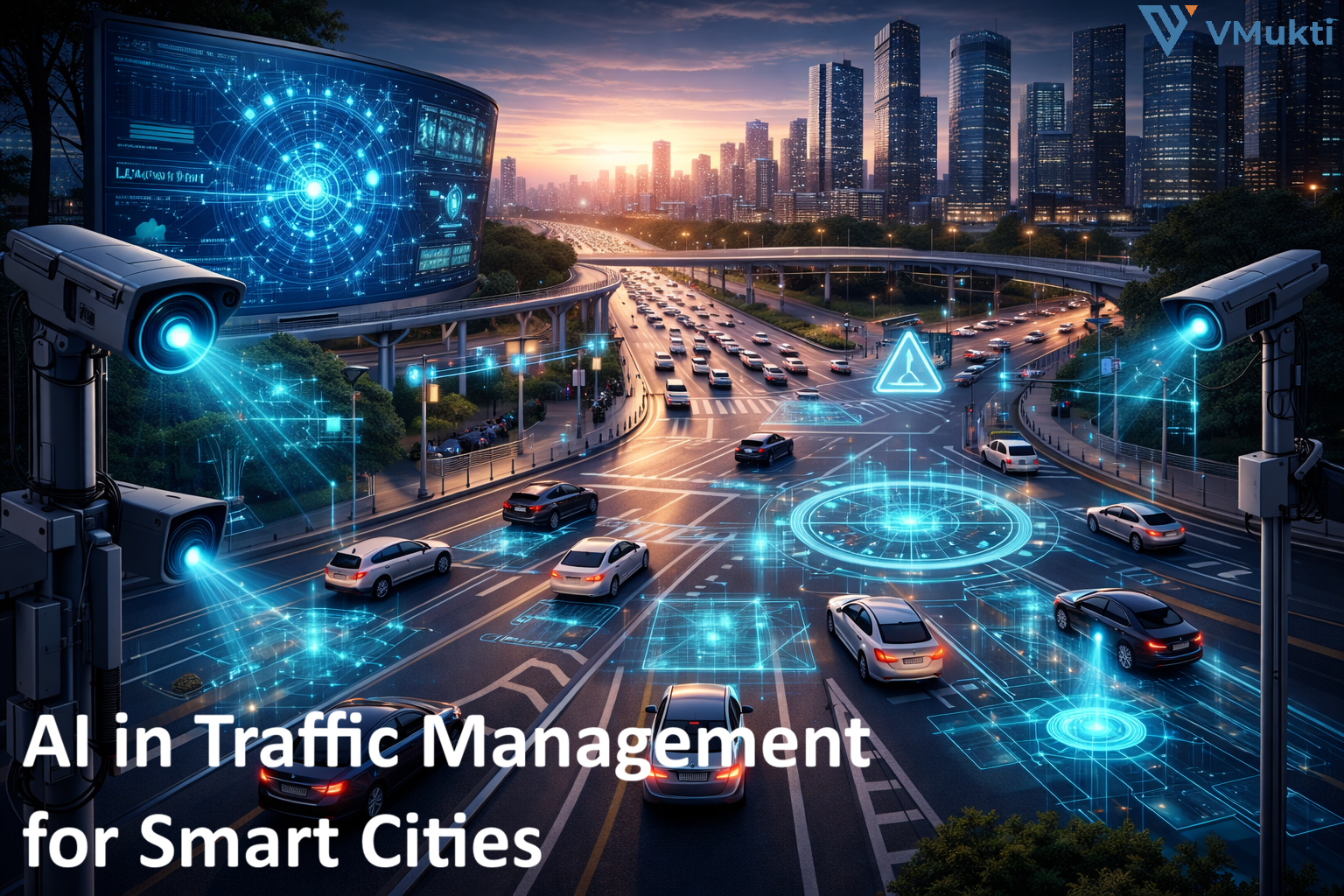
AI in Traffic Management: Transforming Urban Mobility with Intelligent Systems
AI in traffic management is transforming how cities handle congestion, safety, and mobility. Urban roads are becoming more complex due to rapid population growth and rising vehicle density. As a result, traditional traffic systems struggle to adapt to dynamic road conditions.
Today, intelligent traffic management systems use real-time data and predictive analytics to optimize traffic flow. These systems analyze patterns, predict congestion, and adjust operations instantly. As far as modern urban development is concerned, AI-based Traffic Management enables faster decisions and safer transportation infrastructure.
Moreover, AI-powered surveillance for traffic ensures continuous monitoring across intersections and highways. Authorities receive instant alerts, so they can respond quickly to incidents and prevent further disruption.
What is AI in Traffic Management?
AI in traffic management refers to the use of artificial intelligence to monitor, analyze, and control urban road networks. It combines machine learning, computer vision, and traffic video analytics to process live data from cameras, sensors, and connected infrastructure. Unlike traditional fixed-timer systems, AI traffic signal control dynamically adjusts signal timings based on real-time vehicle density. It evaluates traffic patterns, detects congestion, and recommends immediate corrective actions. An AI-based Traffic Management framework continuously learns from traffic flow trends and historical data. As a result, the system improves operational efficiency over time without requiring constant manual supervision.
Limitations of Traditional Traffic Management Systems
How AI Improves Traffic Operations in Smart Cities
AI enhances traffic operations through automation and data-driven intelligence. It analyzes live feeds using traffic video analytics to detect anomalies in real time. For instance, AI traffic signal control dynamically adjusts green light duration based on vehicle density. As a result, waiting time decreases and fuel consumption reduces. AI-powered surveillance for traffic also identifies accidents, stalled vehicles, and wrong-way movement instantly. Authorities receive immediate alerts and initiate faster response protocols. When integrated with a centralized command center such as an ICCC, city officials gain unified situational visibility. Moreover, coordination with Transportation departments strengthens inter-agency decision-making. In addition, predictive congestion analysis helps forecast peak-hour pressure points. The system recommends diversion routes proactively. Therefore, urban road networks operate more smoothly and efficiently.
Key Applications of AI-Based Traffic Management
AI-based Traffic Management enables high-impact applications across modern urban road networks. These applications improve efficiency, safety, and infrastructure planning.
Adaptive Signal Optimization
AI traffic signal control dynamically adjusts signal cycles based on real-time vehicle density. As a result, intersections experience reduced idle time and smoother traffic flow.
Automated Violation Detection
Using traffic video analytics, the system detects red-light violations, over-speeding, and lane indiscipline. This improves enforcement accuracy and strengthens regulatory transparency.
Vehicle Classification and Counting
AI algorithms identify vehicle categories such as cars, buses, and heavy trucks. These insights support long-term infrastructure planning and policy decisions.
Incident and Accident Detection
AI-powered surveillance for traffic detects collisions, stalled vehicles, and abnormal movement instantly. Emergency teams coordinate response efficiently through EMS integration.
Data-Driven Urban Planning
Intelligent traffic management systems provide centralized analytics dashboards. City planners evaluate road utilization, congestion hotspots, and peak-hour trends. Consequently, authorities can optimize layouts and expansion strategies. Together, these capabilities create a scalable and future-ready smart traffic management system.
Benefits and Future Directions
AI in traffic management delivers measurable operational, safety, and sustainability improvements. Below are the key benefits and emerging directions shaping intelligent urban mobility.
Reduced Congestion Through Real-Time Optimization
AI traffic signal control adjusts signal timing based on live vehicle density. As a result, intersections experience smoother flow and shorter waiting periods. Intelligent traffic management systems continuously optimize routes to prevent bottlenecks.
Improved Public Safety and Faster Incident Response
AI-powered surveillance for traffic detects accidents, stalled vehicles, and violations instantly. Authorities receive real-time alerts and coordinate response efficiently. This reduces secondary accidents and improves road discipline.
Lower Operational Costs
Automation reduces dependence on manual traffic supervision. Data-driven systems require fewer on-ground interventions. Therefore, municipalities optimize operational budgets without compromising control.
Environmental Sustainability
Optimized signal cycles reduce idle engine time and fuel waste. Consequently, cities experience lower carbon emissions and improved air quality. AI-based Traffic Management supports long-term green mobility goals.
Future Direction: Cloud, Edge, and Predictive Intelligence
CloudAI platforms will enable centralized multi-location analytics. Edge processing will accelerate on-site decision-making at intersections. Moreover, predictive congestion modeling will help cities prevent gridlock before it occurs.
Future Direction: GenAI and Smart City Integration
Integration with GenAI systems will introduce conversational traffic dashboards. Administrators will interact with live traffic data through intuitive interfaces. As Smart City ecosystems expand, AI in traffic management will become foundational infrastructure.
Real-World Example: Video Analytics Improving Traffic Management
The Challenge: Peak-Hour Congestion
A metropolitan city faced severe congestion during peak hours. Major intersections experienced long vehicle queues and frequent bottlenecks. Traditional signal systems could not adapt to fluctuating traffic density.
The Solution: Deployment of Traffic Video Analytics
Authorities implemented traffic video analytics across critical junctions. The system analyzed live feeds and identified congestion hotspots in real time. AI traffic signal control automatically adjusted signal cycles based on vehicle volume.
The Operational Impact
Within weeks, travel time reduced noticeably across key corridors. AI-powered surveillance for traffic also identified accident-prone zones and abnormal vehicle behavior. Emergency dispatch teams responded faster due to instant alerts. The integrated VMS platform generated historical traffic insights and performance dashboards. City officials used these analytics to redesign traffic flow strategies and optimize intersection layouts.
The Result
Congestion levels declined without major infrastructure upgrades. Enforcement efficiency improved through automated violation detection. As a result, the city achieved measurable performance gains using intelligent traffic management systems.
Why choose VMukti Solutions for AI Video Analytics in Traffic Monitoring and Smart City Infrastructure
VMukti Solutions is a specializing in intelligent surveillance and video intelligence platforms that power modern smart cities. With over 18 years of industry experience and more than 900 successful deployments, VMukti delivers advanced cloud-native solutions for public safety, transportation, and infrastructure monitoring. In the context of traffic, VMukti’s video analytics capabilities support AI-powered surveillance for traffic, including real-time detection of vehicles, anomalies, and congestion patterns. These systems can automatically trigger alerts, identify violations, and drive incident response actions — significantly improving situational awareness at busy intersections and corridors. When deployed within smart city environments, the platform’s ICCC enables coordinated decision-making among traffic management, emergency services, and transport departments. Its cloud-based architecture ensures scalability across multiple zones and seamless integration with legacy infrastructure. In summary, VMukti’s suite of intelligent traffic and urban monitoring solutions turns raw video feeds into actionable insights. This approach supports proactive traffic supervision, reduces response times, and strengthens data-driven governance — all critical components of a smart transportation ecosystem.
Conclusion
AI in traffic management is no longer optional for rapidly growing cities. It delivers operational intelligence, automation, and predictive control across complex urban road networks. Intelligent traffic management systems replace rigid infrastructure with adaptive, data-driven decision-making. As a result, AI-based Traffic Management enhances safety, improves efficiency, and supports long-term sustainability goals. Through traffic video analytics and AI-powered surveillance for traffic, authorities shift from reactive monitoring to proactive traffic governance. Incidents are detected faster, congestion is managed smarter, and resources are utilized more effectively. As urban ecosystems expand and mobility demands increase, AI will continue shaping the future of transportation infrastructure. Cities that adopt intelligent automation today will define the next generation of smart mobility.