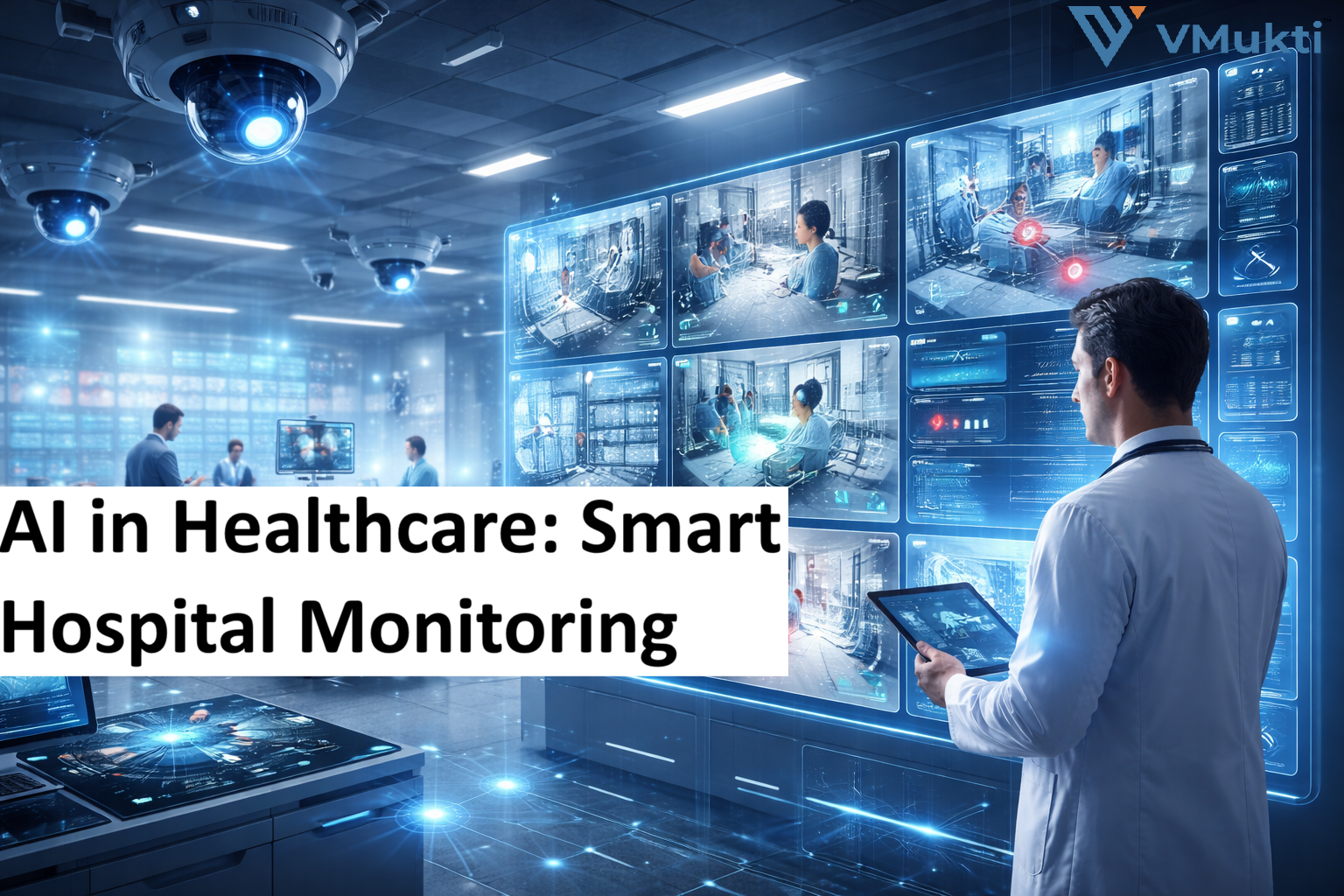
AI in Healthcare: Transforming Patient Care with Intelligent Technology
AI in healthcare is redefining how hospitals deliver patient care, manage operations, and improve medical decision-making. Healthcare facilities today face growing challenges such as increasing patient volumes, operational complexity, and the need for faster clinical responses. Traditional hospital monitoring and administrative systems often struggle to keep up with these demands.
Modern healthcare environments are now adopting AI-powered healthcare monitoring systems that analyze real-time data and provide actionable insights. These systems assist doctors, nurses, and hospital administrators in improving patient safety, optimizing workflows, and reducing operational inefficiencies.
Moreover, AI-powered video analytics in healthcare enables hospitals to monitor critical environments continuously. From patient safety monitoring to operational oversight, AI helps healthcare providers detect risks instantly and respond faster. As a result, healthcare institutions can deliver safer, smarter, and more efficient medical services.
What is AI in Healthcare?
AI in healthcare refers to the application of artificial intelligence technologies such as machine learning, computer vision, and predictive analytics to support medical decision-making, patient monitoring, and hospital operations. AI systems process large volumes of healthcare data from cameras, sensors, medical devices, and hospital information systems. These intelligent systems analyze patterns, detect anomalies, and provide insights that assist healthcare professionals in making faster and more accurate decisions. Unlike traditional monitoring systems that require constant manual supervision, AI healthcare systems operate continuously and learn from historical data. Over time, these systems become more accurate in identifying risks, predicting health trends, and improving hospital efficiency.
Limitations of Traditional Healthcare Monitoring Systems
Many healthcare facilities still rely on conventional monitoring and management methods that lack automation and predictive intelligence. Common limitations include: Because of these limitations, hospitals require AI-based healthcare monitoring solutions that provide continuous, intelligent supervision across the entire facility.
How AI Improves Healthcare Operations
AI enhances hospital operations by analyzing data from multiple sources and converting it into real-time insights. For example, AI-powered video analytics in hospitals can monitor patient movement, detect unusual activity, and ensure safety in critical areas. If a patient falls or remains inactive for an extended period, the system immediately alerts hospital staff. AI also improves hospital workflow optimization by monitoring waiting areas, emergency departments, and corridors. By analyzing patient movement patterns, hospitals can allocate resources more efficiently. Additionally, AI helps ensure compliance and safety in restricted medical areas such as operation theatres, ICUs, and pharmaceutical storage zones. When integrated with centralized command platforms, healthcare administrators gain a unified view of hospital operations. This improves coordination among departments and enables faster response to incidents.
Key Applications of AI in Healthcare
AI in healthcare enables multiple high-impact applications across hospitals and medical facilities.
Patient Safety Monitoring
AI systems monitor patient rooms and wards using intelligent video analytics. The system can detect falls, unusual patient movements, or prolonged inactivity. Healthcare staff receive instant alerts, enabling faster medical response.
Hospital Security and Restricted Zone Monitoring
Healthcare facilities contain sensitive areas such as laboratories, ICUs, and medicine storage units. AI-powered surveillance systems monitor these zones and detect unauthorized access or suspicious activity.
PPE Compliance Monitoring
AI vision systems can detect whether healthcare staff are wearing proper personal protective equipment (PPE). This helps hospitals maintain safety standards and infection control protocols.
Patient Flow and Crowd Management
AI analytics track patient movement across waiting areas and departments. Hospitals can analyze congestion patterns and improve resource allocation to reduce waiting times.
Asset and Equipment Monitoring
Hospitals rely on critical equipment such as ventilators, diagnostic devices, and medical carts. AI systems help monitor equipment movement and ensure essential assets remain available where needed.
Together, these applications enable hospitals to build intelligent healthcare monitoring ecosystems that improve safety, efficiency, and operational visibility.
Benefits and Future Directions
AI in healthcare offers measurable improvements in patient safety, hospital efficiency, and healthcare management.
Improved Patient Safety
AI monitoring systems detect patient falls, abnormal movement, and medical emergencies in real time. This allows healthcare staff to respond quickly and prevent complications.
Enhanced Hospital Efficiency
Automation reduces the burden of manual monitoring. Healthcare administrators gain data-driven insights to improve hospital operations and resource allocation.
Faster Incident Detection
AI-powered monitoring identifies anomalies instantly, enabling rapid response from medical teams.
Operational Cost Optimization
AI systems help hospitals streamline workflows and reduce operational inefficiencies. Over time, this leads to improved resource utilization and lower administrative costs.
Future Direction: Predictive Healthcare Intelligence
Future AI healthcare systems will use predictive analytics to forecast patient risk patterns and hospital demand trends. This will help hospitals prepare resources in advance and improve patient outcomes.
Future Direction: Integrated Smart Hospital Ecosystems
AI systems will integrate with smart hospital infrastructure, combining medical data, monitoring systems, and operational platforms. This will create fully connected healthcare environments capable of intelligent decision-making.
Real-World Example: AI Monitoring Improving Hospital Operations
The Challenge: Patient Safety and Operational Visibility
A large hospital faced challenges in monitoring patient safety across multiple wards. Manual supervision made it difficult to track patient movement and detect incidents quickly.
The Solution: AI-Powered Video Analytics Deployment
The hospital implemented AI-powered video analytics across patient wards, corridors, and emergency departments. The system continuously monitored patient activity and detected unusual behavior patterns.
The Operational Impact
Within a short period, the hospital improved incident detection and reduced response times for patient emergencies. AI alerts enabled nurses and medical staff to intervene quickly during critical situations. The platform also provided operational insights into patient flow and waiting area congestion, helping administrators optimize hospital operations.
The Result
The hospital achieved better patient safety monitoring and improved operational efficiency without requiring significant infrastructure changes.
VMukti’s AI Video Analytics for Healthcare Monitoring
VMukti Solutions is a leading provider of intelligent video analytics and that support healthcare facilities in improving safety and operational visibility. With over 18 years of experience and more than 900 deployments worldwide, VMukti delivers scalable solutions for hospitals, healthcare campuses, and medical institutions. In healthcare environments, VMukti’s AI video analytics enable: These capabilities help hospitals transform raw video data into actionable insights that improve medical response and operational awareness. When deployed within centralized monitoring environments, VMukti’s platform enables healthcare administrators to supervise multiple departments from a single command interface. As a result, hospitals gain better situational awareness, faster response capabilities, and improved decision-making.
Conclusion
AI in healthcare is rapidly transforming how hospitals manage patient care, safety, and operations. Intelligent systems enable healthcare providers to move beyond reactive monitoring toward proactive healthcare management. Through AI-powered video analytics, predictive insights, and intelligent monitoring, healthcare facilities can improve patient safety, streamline hospital workflows, and enhance operational efficiency. As healthcare systems continue to evolve, AI will play a crucial role in building smarter hospitals and more responsive healthcare infrastructure. Organizations that adopt AI-driven healthcare monitoring today will lead the future of intelligent medical services.